
What Is a Compound Neck Profile? | RJ Guitars Guide
- Jan 5
- 7 min read
Updated: Jan 6
What Is a Compound Neck Profile—and Why It Might Change the Way You Play
Every guitarist has experienced it—that moment when you pick up an instrument and it just feels right. Your hand settles into place, barre chords snap into focus, and those lightning-fast runs suddenly feel effortless.
More often than not, the secret isn't in the pickups or the wood. It's in the neck profile.
Yet here's what most players don't realize: while compound radius fretboards have become relatively common, true compound neck profiles—where the back shape of the neck transitions along its length—remain exceptionally rare. Even Fender's Custom Shop only offers their C-to-D compound profile through special order, and most boutique builders either don't offer it at all or charge significant upcharges for the extra hand-shaping required.
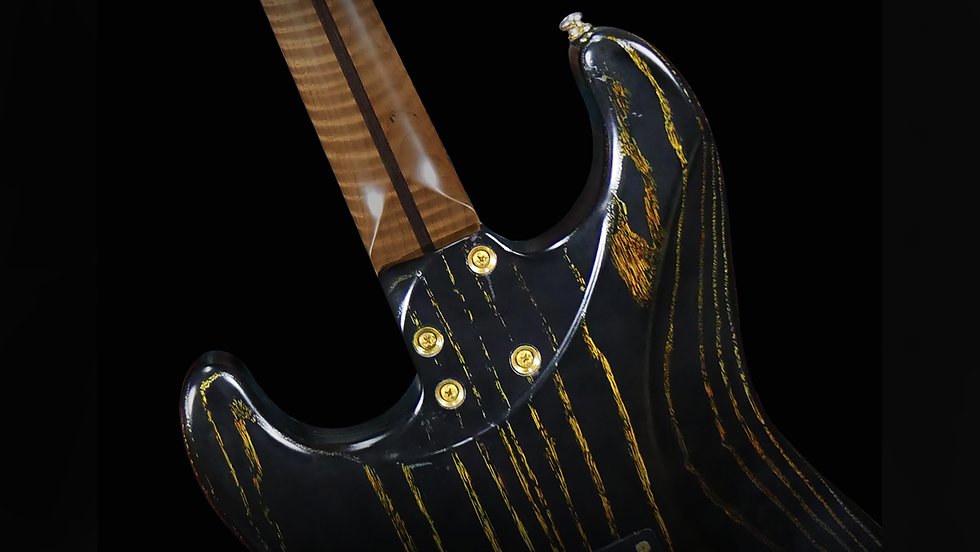
At RJ Guitars, we've spent years refining our proprietary RJ Compound Neck—a design that transitions seamlessly from a comfortable soft V at the nut to a modern C shape at the upper frets. While we operate as a custom shop, this isn't a special order feature or an expensive add-on. It's standard on every guitar we build, included at no extra cost.
It's the kind of detail that separates a good guitar from an instrument that becomes an extension of your playing.

What Is a Neck Profile? (And Why It Matters More Than You Think)
Your neck profile is the cross-sectional shape of the guitar neck—essentially how it fills your fretting hand when
you're playing.
Think of it as the difference between gripping a baseball bat versus a broomstick. Both are round, but the way
your hand wraps around them is completely different. The same principle applies to guitar necks.
Traditional profiles include:
Modern C shape: Shallow, rounded, and fast—the go-to for shredders
Soft V neck: Fuller with a subtle ridge, offering more support for the thumb
U shape: Thick and chunky, popularized in the '50s
D shape: Flattened back, splitting the difference between comfort and speed
Each has its devoted followers. But here's the thing: your hand doesn't stay in one position when you play.
What Makes a Profile "Compound"? (And Why It's So Rare)
A compound neck profile guitar doesn't maintain a single shape from nut to heel. Instead, it transitions
gradually along the length of the neck to match the natural shifts in your hand position and playing technique.
This is distinctly different from a compound radius fretboard (which changes the curvature of the fretboard
surface). A compound profile changes the back shape of the neck itself—a far more complex undertaking that
requires master luthiers with years of experience to execute by hand.
Why So Few Manufacturers Offer It
The reason compound profiles are rare comes down to economics and craftsmanship:
Mass manufacturers rely on CNC machines that can only produce uniform shapes efficiently
Hand-shaping a compound profile requires master luthiers with years of experience
The time investment per neck is significantly higher than automated production
Custom shops that do offer compound profiles typically charge upcharges of several hundred dollars
Quality control becomes more challenging without the "consistency" of machine production
Even among high-end boutique guitars, you're far more likely to find a uniform C or D shape than a true
compound profile.
The RJ Compound Neck: Soft V to Modern C
Our design starts with a soft V profile at the lower frets (1st-5th). This fuller shape provides:
Natural thumb support for rhythm playing and power chords
Stability for barre chords without gripping fatigue
That vintage "reference point" feel that many players subconsciously rely on
As you move up the neck, the profile gradually morphs into a modern C shape by the 12th fret and beyond.
This slimmer, faster profile delivers:
Reduced hand fatigue during lead work
Faster string-to-string movement for complex runs
Better clearance for aggressive vibrato and bends
The transition is so gradual that most players don't consciously notice it—they just feel the guitar adapting to
them, rather than forcing them to adapt to it.

How RJ Guitars Engineered the RJ Compound Neck
Creating a compound profile isn't simply about sanding down a uniform neck. It requires precision engineering, premium materials, and old-school craftsmanship.
Quarter-Sawn Maple for Stability
We start with quarter-sawn maple—the gold standard for neck construction. Unlike flat-sawn lumber, quarter-sawn cuts expose vertical grain lines that resist warping and twisting, even under string tension and humidity changes.
This stability is critical for compound profiles, where even slight warping can disrupt the carefully calculated
transition zones.
Pure Hand-Shaping by Master Luthiers
Unlike mass manufacturers who rely on CNC machines for consistency, every RJ Compound Neck is shaped
entirely by hand from start to finish. This traditional approach allows our luthiers to feel the wood, adjust for its unique characteristics, and ensure the transition between profiles is perfectly smooth.
Our master craftsmen:
Smooth the transitions between profile zones
Add semi-rolled edges along the fretboard binding for that broken-in feel
Ensure perfectly level fret installations with stainless steel frets for superior durability and playability
Performance Hardware as Standard
We believe a compound neck deserves equally thoughtful hardware:
Lubri-nut: Our proprietary bone nut material combines the tonal warmth of natural bone with self-
lubricating properties (similar to TUSQ XL) to prevent string binding and improve tuning stability
Wilkinson or Gotoh locking tuners: Your choice of premium tuners that hold pitch under aggressive
playing and speed up string changes
Stainless steel frets: Outlast nickel-silver by years, maintain their crown longer, and provide silky-
smooth bends
Tone and Technique Benefits: Why Compound Profiles Change Your Playing
Playability Across Every Style
The compound neck profile isn't about specialization—it's about versatility. Whether you're:
Laying down rhythm parts with full barre chords
Executing rapid-fire alternate picking runs
Bending strings two steps on the high E
Hammering out blues licks with vocal-like vibrato
...the neck shape supports your hand exactly where it needs to be.
Thumb Positioning Freedom
One of the most underrated benefits? Natural thumb placement.
In lower positions, the soft V encourages your thumb to rest behind the neck (classical position), providing leverage for complex chord voicings. As you move into lead territory, the modern C shape allows thumb-over-
the-top techniques popularized by players like Hendrix and Mayer—perfect for muting strings or adding bluesy thumb-fretted bass notes.
You're not fighting the neck. You're flowing with it.
Reduced Fatigue = Longer Practice Sessions
Forcing your hand to conform to a single neck shape for hours creates tension in your forearm, wrist, and
thumb. A compound profile distributes that workload across different muscle groups as you move up and down the neck.
Translation? You can practice longer, play harder sets, and maintain technique deep into that third encore.
Lead Guitar Comfort Without Sacrificing Chord Work
Here's the traditional trade-off: chunky vintage necks feel great for rhythm but slow you down on leads. Thin
shred necks are lightning-fast but feel insubstantial for chord work.
The compound neck profile guitar eliminates that compromise entirely.
How the RJ Compound Neck Compares to Traditional Profiles
Profile Type | Best For | Limitations | RJ Compound Advantage |
Modern C | Lead playing, speed, shredding | Can feel thin and unsupportive for rhythm | Provides C-shape speed at upper frets while maintaining body at nut |
Soft V | Vintage feel, chord work, thumb support | Can feel chunky and slow for lead work | Transitions away from V as you move into lead positions |
U Shape | Players with larger hands, vintage tone | Too thick for most modern techniques | Offers support without excessive thickness |
D Shape | Balanced all-arounder | Jack of all trades, master of none | Purposefully adapts rather than compromising |
The key insight? Traditional profiles ask you to adapt to them. The compound profile adapts to you.
How to Know If a Compound Neck Profile Is Right for You
A compound neck makes the most sense if you:
✔ Play multiple styles (rhythm, lead, fingerstyle) in the same song or set
✔ Experience hand fatigue with thin shred necks or chunky vintage profiles
✔ Use varying thumb positions depending on what you're playing
✔ Frequently play both open position and upper fret work
✔ Want one guitar that can handle everything from jazz chords to metal leads
You might not need a compound profile if you:
Only play in one specific position (e.g., exclusively rhythm guitar in first position)
Have already found your perfect uniform profile and never experience discomfort
Prefer the consistency of knowing exactly what shape you're grabbing regardless of position
That said, most players who try a well-executed compound neck don't go back. The adaptability simply makes
sense once you experience it.

The RJ Guitars Difference: Custom Shop Quality Without Custom Shop Pricing
Here's what makes RJ Guitars unique in the boutique guitar world:
Standard, Not Special Order
While we operate as a custom shop, our compound neck profile comes standard—no upcharge, no special
order required. This is the kind of feature that typically adds hundreds of dollars to a Fender Custom Shop order or requires boutique pricing elsewhere.
True Boutique Quality at Accessible Prices
We're delivering true custom shop craftsmanship at prices that compete with—and often undercut—mass-
produced American Fenders. In fact, most of our instruments are priced lower than standard USA-made Fender models, while including premium specs that would cost extra almost anywhere else:
Quarter-sawn maple necks (often a $100-150 upcharge elsewhere)
Stainless steel frets (typically $50-100 extra)
Premium locking tuners (usually $100+ upgrade)
Hand-wound pickups (custom shop territory)
Compound neck profile (rarely offered, expensive when available)
Handcrafted in the Philippines
We're proud to bring boutique-level innovation to players worldwide—designed and handcrafted right here in
the Philippines. Every neck is shaped entirely by hand, allowing our luthiers to create transitions that machines simply cannot replicate. Every guitar represents the intersection of traditional lutherie and modern precision in hardware and materials.
Experience the RJ Compound Neck: Custom Shop Craftsmanship, Filipino Pride
At RJ Guitars, we believe you shouldn't have to choose between custom features and accessible pricing. Our RJ Custom Shop models feature the proprietary RJ Compound Neck as standard, along with premium tonewoods, hand-wound pickups, and hardware specs you'd expect from instruments costing significantly more.
Ready to Feel the Difference?
We invite you to experience what a thoughtfully designed compound neck profile can do for your playing:
Visit our showroom to test RJ Custom Shop models in person
Contact us for detailed specifications and custom build options
Follow @rjguitarsofficial for player testimonials and neck profile deep dives
Because the right neck isn't about following trends—it's about finding the perfect fit for your hands, your
technique, and your music.
Contact RJ Guitars → hello@rjplanet.com
RJ Guitars | Handcrafted in the Philippines | Where Innovation Meets Tradition

Comments